Saturday, March 7, 2015

Antifouling

I did not know what kind of antifouling has used the previous owner. I decided to strip what I can. Applied two layers of Primocon folowed by one layer of Cruiser UNO both from International. I renewed the waterline afterwards.

Wednesday, February 4, 2015

Running rig

My running rig looks quite old, so I decided to change it. The answer to the question what kind of lines I need appeared not to be very straight forward. I searched in Internet and different forums, but people suggested lines basically based on the lines diameter, but not the line strength. I think it is clear to everyone that a line with smaller diameter in some cases could be tougher than a line with larger diameter. Finally I found some formula by which one could calculate the approximate load on a Genoa and Main sheet, which numbers could be a good starting point when you decide about the lines:
1. Genoa.
So, about the Genoa it looks pretty straight forward:
SL = SA x V² x 0.02104
Where: SL = Sheet Load in kilogramsSA = Sail Area in square metersV = wind speed in knots
For Genoa number 1 (about 18 square meters), and a wind speed of let say 40 knots, the sheet load in kilograms will be about 600 kilograms force or 600 daN.
For storm sail (about 5 square meters), and a wind speed of let say 100 knots, the sheet load in kilograms will be about 1052 kilograms force or 1052 daN.
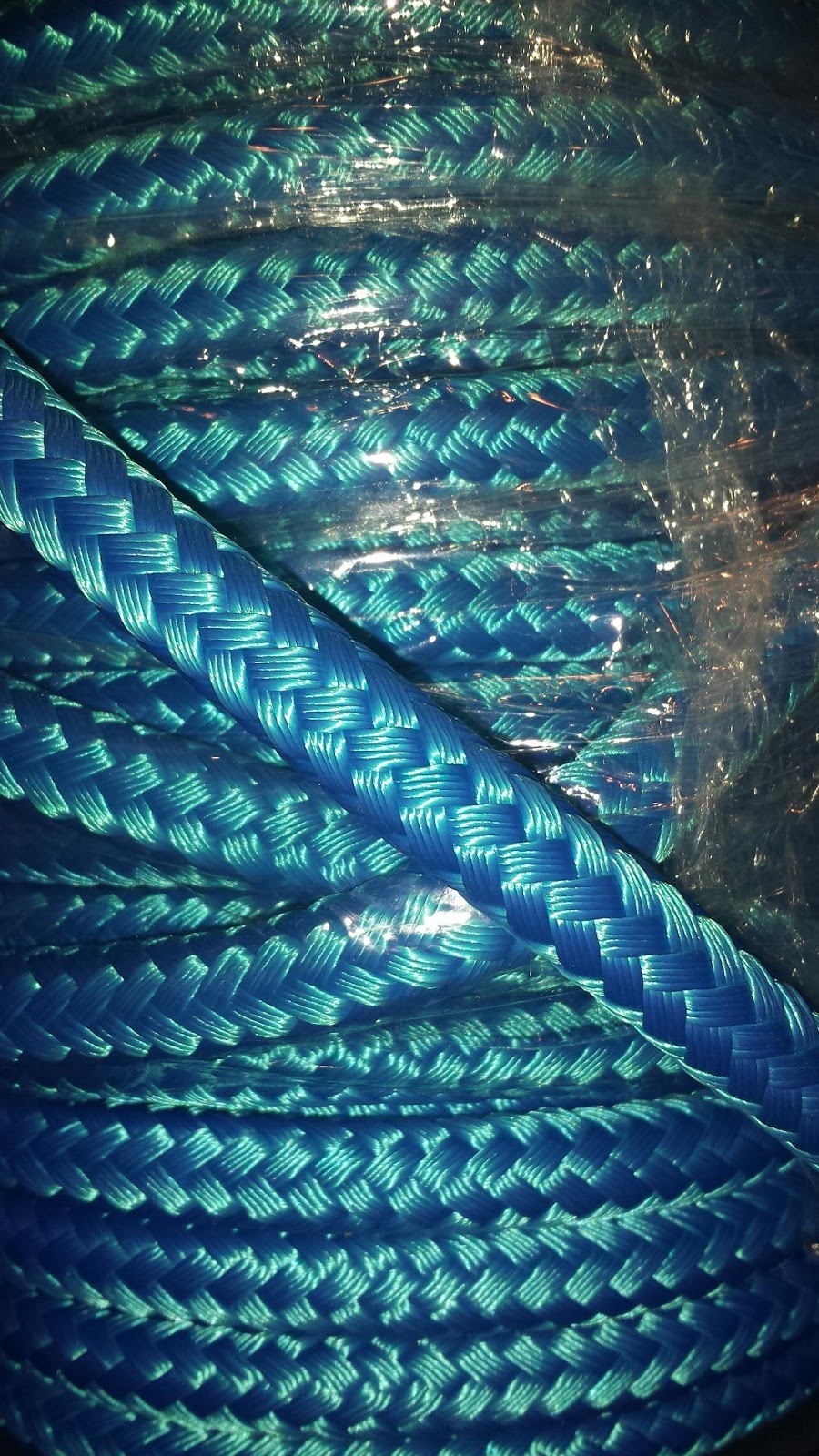
I decided to get for a Genoa sheet line of 12 mm with strength of 3014 daN (Hurricane polyester double braided Lanex sheet).
I think that it is unlikely that the Genoa sheet of Contessa could suffer more than 1052 daN, if it happens the Genoa sheet will be the smallest problem which you will have to deal with.
For the Genoa halyard I decided to go for 3600 daN Dynema 8 mm line.
2. Main sail.
Estimate of the main sheet load could be made by the following formula:
ML = E² x P² x 0.02104 x V² / (sqrt (P² + E²) x (E - X))
Where:
ML = Mainsheet Load in kilograms
E = Foot length on main in meters
P = Luff length of main in Meters
V = Wind speed in knots
X = Distance from aft end of boom to mainsheet attachment point.
For Main sail (about 12 square meters), and a wind speed of let say 60 knots, and X = 0.5 m the sheet load in kilograms will be about 685 kilograms force or 685 daN.
I decided to go for the same lines as for the Genoa, Main sheet line of 12 mm with strength of 3014 daN (Hurricane polyester double braided Lanex sheet), and Main halyard of 3600 daN Dynema 8 mm line.
My traveler blocks are 4:1 system, which I expect to reduce the force on the main sheet by factor of 3, and I decided to go for blocks with working load of 700 daN.
For the boom vang, I decided to go for 500 daN blocks 4:1 system and 10 mm lines 2500 daN.
More information about the sheet load one can find here:

Saturday, December 6, 2014

Rebedding the deck hardware

It was a lovely day today in the Marina Den Oever (the name of the American city Denver originates from over here :). I decided to rebed all the deck hardware, stanchions, cleats, and chain plates :)
Lovely evening in Marina Den Oever
Rebedding hardware.

Saturday, November 29, 2014

Re-bedding the chain plates with poly butyl tape.

I decided before the winter really comes to re-bed the chain plates. In the Don Casey book "Sailboat Maintenance Manual" actually the recommended material is polysulfide sealant. I visited more than 5 shops here in Netherlands, and I did not find such a sealant. Because of that, I started to look for alternatives. I found several reviews and sailors in Internet who actually recommend the use of polybutyl tape when sealing movable deck hardware like the chain plates and stanchions. I found such a tape in the shop called KOK-Watersport: poly butyl tape KOK watersport. 3 meters of it cost just 6.50 Euro. The procedure which I found is pretty basic. 

1. Remove chain plates.
2. Clean and Dry chain plates and the through holes.
3. Repair the deck with epoxy if necessary.     
4. Apply the poly butyl tape.
5. Tighten the chain plates.
6. Remove the excess of the poly butyl tape.

Cleaned chain plate.
Poly butyl tape applied.
Tightened chain plate.
Removing the excess of the sealant.

Sunday, September 28, 2014

Rigging Notes

I just checked the rigging tension. Decided to make everything on 10% of ultimate breaking strength except for the capping shrouds which were set to 15%. I found the information about rigging here:
The explanation which I liked the most was the following:
"Note From Nigel Charlesworth (UK) regarding accurate mast rake.
I have a measured drawing of Birgitta (Rogers CO26) which shows the original configuration and the modifications required to achieve a 2 degree mast rake. It meant chopping 125 mm off the backstays (dia = 4 mm) and increasing the forestay length (dia = 5 mm) by 110 mm. I used Staloks. No changes were made to the capping or the lower shrouds. The standing rigging was re-tensioned, using a “Sure-Rig” tension meter as follows: everything 10% of ultimate breaking strength except for the capping shrouds which were set to 15%. When this was all done, the main halyard was dropped to the deck into a bucket of water and the distance from its bottom to the mast step was measured and found to be 295 mm which gives a 2 degree rake. Birgitta was put on the water, sailed and the standing rigging re-tensioned. Prior to any of this we were tacking through 115 degrees. Post static tensioning we tacked through 90 degrees, and after the dynamic re-tensioning we achieved 85 degrees in a 15 – 20 knot breeze. What was interesting was that it was the lower fore shrouds that create an automatic pre-bend. Equally interesting is that the flatter the sails the better the tack. By just slightly loosening the main and genoa luffs and easing the vang the tacking angle increases to 95 degrees."

Interior layout.

A lot of people ask me how Sasha looks from inside :) Here it is :)